
1. The short answer
Never put personal data of the company, of clients or of staff into a personal AI account (including paid ones: Pro, Plus, Max or Go). With a business plan, training turned off, people informed and a short list of approved uses, you can use these tools with peace of mind and without asking each person for consent.
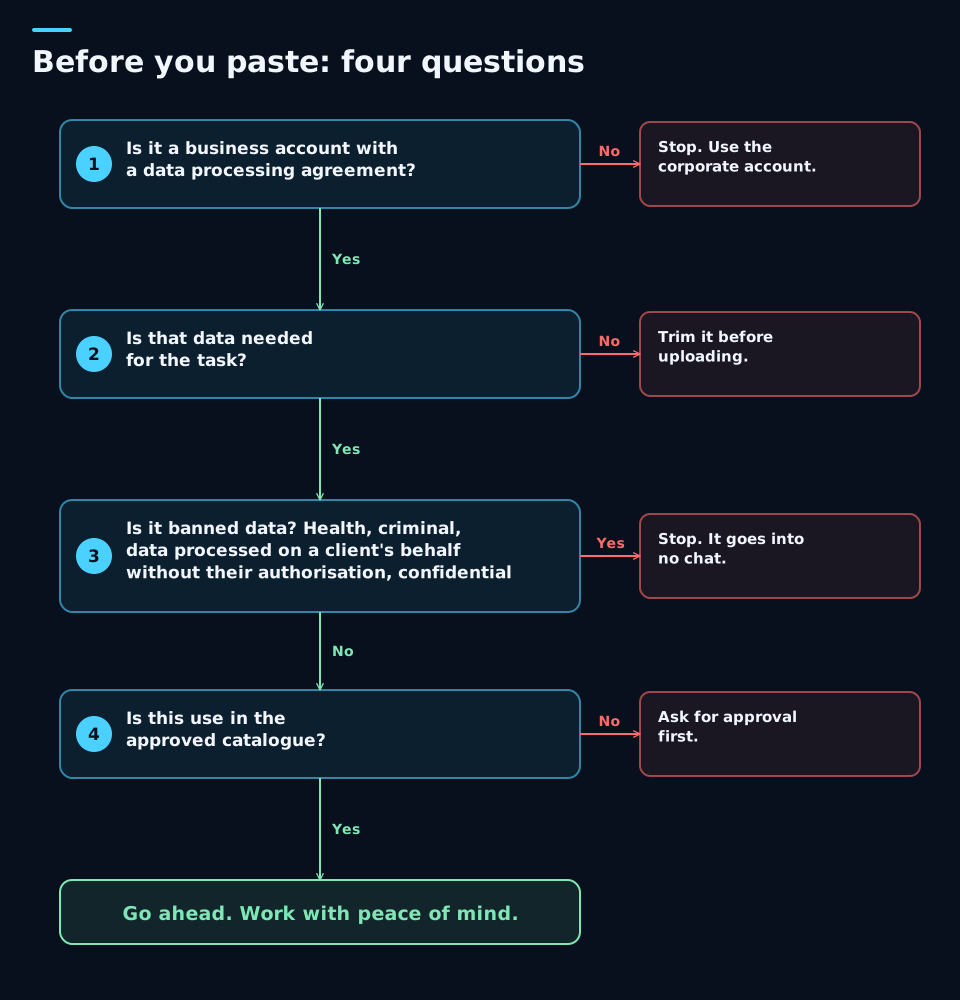
Before pasting anything into a chat, four questions. Is it a business account with a data processing agreement? Is that data needed for the task? Is it a permitted type of data? Is that use on the approved list? Four yeses, go ahead. One no, stop.
2. The account matters more than the tool
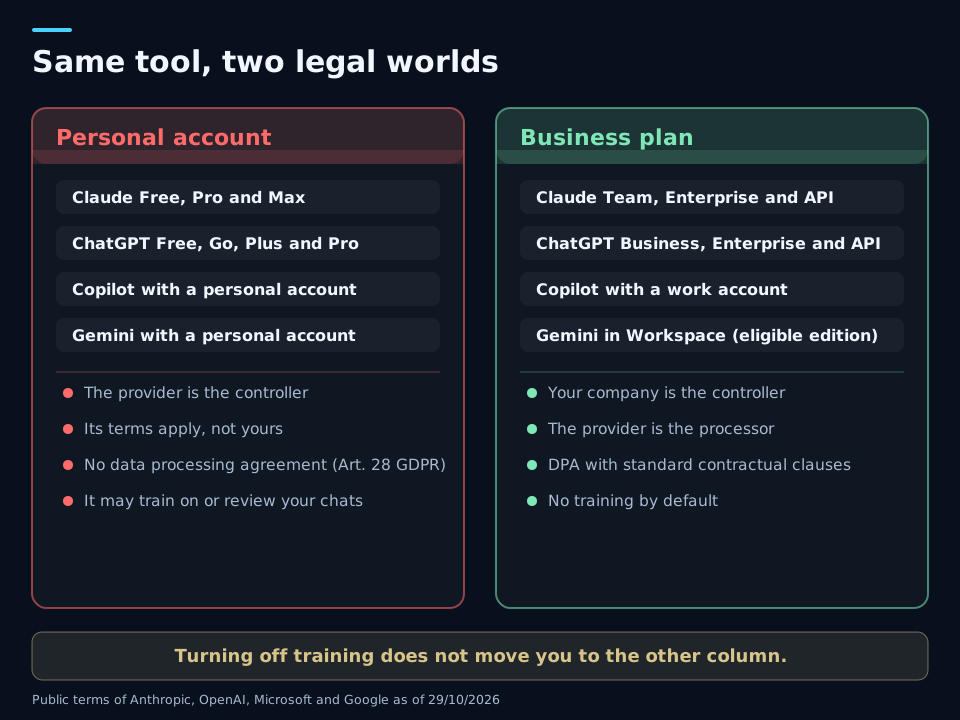
The same tool changes its legal nature depending on the account. With a personal account (including paid ones: Pro, Plus, Max or Go), the provider processes your data as a controller and under its own terms. With a business plan, the data processing agreement is part of its terms, which is what Article 28 GDPR requires when someone processes data on your behalf.
I have read the public terms of the four providers on 29 October 2026. This is what they say, in their own words.
| Plan | Data processing agreement? | What the provider says | Source and date |
|---|---|---|---|
| Claude Free, Pro and Max | No | Consumer products. For EEA residents, their terms state: "You agree that you will not use our Services for any commercial or business purposes". | Anthropic, EEA consumer terms (08/10/2025) |
| Claude Team, Enterprise and API | Yes | "The customer is the Controller" and "Anthropic acts as a Processor". The DPA with standard contractual clauses is incorporated into the commercial terms. | Anthropic, privacy centre: controller and processor roles (consulted 29/10/2026) and DPA (16/03/2026) |
| ChatGPT Free, Go, Plus and Pro | No | The Services Agreement "does not apply to OpenAI services used by consumers or individuals". Minimal exception: ChatGPT Sites has a DPA only for the data collected by the published site, which "does not apply" to your prompts or files. | OpenAI, Services Agreement (01/01/2026) and ChatGPT Sites DPA (09/07/2026) |
| ChatGPT Business, Enterprise and API | Yes | The DPA "supplements, and is incorporated into, the OpenAI Services Agreement" and OpenAI "acts as a Data Processor". | OpenAI, DPA (01/01/2026) |
| Copilot with a personal account | No | "Copilot in Microsoft 365 apps is covered by the Microsoft Services Agreement". The Copilot terms for individuals add: "You can only use Copilot for your own personal use". | Microsoft Support and Copilot terms for individuals (consulted on 29/10/2026) |
| Copilot with a work account | Yes | Covered by the DPA and the Product Terms "with Microsoft acting as a data processor". Bing web searches are excluded: there Microsoft "acts as an independent data controller". | Microsoft Learn (18/08/2026) |
| Gemini with a personal account | No | Human reviewers read some of the chats and "Reviewed chats are retained for up to three years". Google asks: "Please don't enter confidential information that you wouldn't want a reviewer to see". | Google, Gemini Apps Privacy Hub (26/10/2026) |
| Gemini in Google Workspace (eligible edition) | Yes | "User prompts are considered customer data under the Cloud Data Processing Addendum". Only with a Workspace edition that meets the requirements. | Google Workspace, Privacy Hub (06/10/2026) |
Turning off training is no substitute for the data processing agreement: they are two different things. And a Workspace Individual licence has a data processing agreement for professional use, but Gemini is listed there as an "additional service" under Google's consumer terms (consulted on 29/10/2026).
3. Where your data goes and how long it stays
Signing up for a business plan settles the processing agreement. On its own it does not settle where the data is processed or how long it is kept. Four things worth knowing before you sign.
Claude stores in the United States and routes wherever Anthropic decides
Anthropic says that "data is stored in the US" and that, by default, it may route traffic to "select countries in the US, Europe, Asia and Australia, unless otherwise agreed upon". The only regional option in claude.ai is "US-only inference", available only for Enterprise with usage-based billing and with a 1.1 multiplier on the usage rates of recent models (10% more, with seat fees unchanged). In the API, the inference_geo parameter accepts "global" or "us". There is no "EU only" option in the direct service. To process in Europe you have to go to Claude on Amazon Bedrock or on Google Cloud and check the model, the inference profile and the scope (Anthropic, 15/06/2026).
Chats do not expire on their own
In Claude Team and Enterprise, chats are kept until someone deletes them. Once deleted, they leave the systems within an ordinary period of 30 days. Incognito chats are deleted automatically within 30 days. If a safety system flags a conversation, up to 2 years, and its score up to 7 years. If someone clicks the button to rate a response, the conversation can be kept for up to 5 years and used for training. Team and Enterprise owners can turn that button off. Custom retention periods are Enterprise only (Anthropic, 01/07/2026 and 18/08/2026).
Copilot can leave the EU at peak times
Microsoft enables "flex routing" by default in eligible tenants (those within the EU Data Boundary) created after 25 March 2026. With it, inference can run in the United States, Canada or Australia during demand peaks. It can be turned off in the Microsoft 365 admin centre. In addition, Anthropic models inside Copilot fall outside the EU Data Boundary (Microsoft Learn, 29/09/2026 and 18/08/2026).
European region in ChatGPT and Gemini: only on the higher plans or with an add-on
OpenAI offers data residency in Europe, and also inference residency, for ChatGPT Enterprise and Edu customers and for the API. Its help article does not mention Business. In Google Workspace, editions with data regions store Gemini chats in region, but in-region processing is only covered by Enterprise Data Regions (included in Enterprise Plus, Enterprise Essentials Plus and Frontline Plus, or as a paid add-on for editions with Fundamental Data Regions) and Assured Controls (add-on). Gemini Notebook is excluded (OpenAI and Google, consulted on 29/10/2026).
I filtered the list of active participants in the EU-U.S. Data Privacy Framework on 29 October 2026. Microsoft Corporation and Google LLC appear. Anthropic and OpenAI do not. Their data processing agreements rely on the standard contractual clauses, so it is up to you to document that this safeguard works for the service and the actual destinations. It can be a brief assessment, following Recommendations 01/2020 of the European Data Protection Board.
4. The 12 things you cannot do (and what to do instead)
Each rule carries its label. "Law" is an obligation with an article behind it. "Recommendation" is professional judgement on how to comply without drama. First what not to do, then the alternative.
-
1
Using personal accounts with company or client data
LawNoPasting a contract, a client list or a medical report into ChatGPT Plus, Claude Pro, a personal Copilot or a personal Gemini, even if the company pays for the account.
InsteadA business plan with a data processing agreement: Claude Team, Enterprise or API, ChatGPT Business, Enterprise or API, Copilot with a work account or Gemini in an eligible Workspace edition. And, as an organisational measure I recommend, blocking personal accounts on corporate devices.
Basis Art. 28 GDPR. In consumer Claude for the EEA, commercial use is also prohibited by its terms (section 11).
-
2
Uploading data that requires special safeguards to a general-purpose assistant
RecommendationNoPasswords, keys and tokens. Data on health, ideology, trade union membership, sexual orientation or biometrics. Criminal data. Data you process on behalf of a client without their authorisation for that provider. Information protected by a confidentiality agreement.
InsteadAn internal list of banned data, by type of data and not by file name. Content is what counts: a quote can contain a diagnosis. Before uploading, trim what adds nothing.
Basis Arts. 9 and 10 GDPR for special categories and criminal data, which may only be processed under an exception and with safeguards. The GDPR has no "list of data banned from AI": this list is a recommendation built on the requirements of each type of data.
-
3
Adding the AI provider as a sub-processor without your client knowing
LawNoProcessing with AI data that you handle on behalf of a client without their prior written authorisation for that provider.
InsteadIf your data processing agreement contains a general authorisation, notify the client beforehand and give them the chance to object. If it is specific, request written authorisation. The sub-processor takes on the same obligations as you.
Basis Arts. 28.2 and 28.4 GDPR. AEPD guidelines on contracts between controllers and processors, section 11.
-
4
Believing that removing the name is anonymising
LawNoDeleting the name and leaving the job title, the town, the date of the accident and the amount. That person is still identifiable.
InsteadAsk yourself whether someone, with what remains and what they already know, can get back to the person. If the answer is yes, it is still personal data and is treated as such. For most tasks, uploading only what is needed is enough.
Basis Art. 4.1 and Recital 26 GDPR: data relating to a person who is identifiable "directly or indirectly" is personal data.
-
5
Processing data with AI without saying so in your privacy information
LawNoUsing AI providers as data recipients without them appearing, at least by category, in the information you give to clients, candidates and staff.
InsteadUpdate the information: recipients or categories of recipients (technology and AI providers), transfers outside the EEA with their safeguard and how to obtain a copy. Categories are fine, as specific as possible, but have the actual providers identified in case someone exercises their right of access. If the change is relevant to people who have already given their data, communicate it before the new use through a channel that reaches them. No mass mailing is needed.
Basis Arts. 13.1.e and f and 14.1.e and f GDPR. Time limits in Art. 14.3: one month at most, or earlier if you communicate with the person or disclose their data. Transparency guidelines WP260 rev.01, annex.
-
6
Letting AI alone decide something with legal or similarly significant effects on a person
LawNoRejecting a candidate, refusing a loan or closing an account based solely on a model's output. A box-ticking "human review", where a person signs off whatever the machine says, does not count.
InsteadArticle 22 applies when the decision produces legal effects or similarly significantly affects the person: rejecting, refusing, dismissing, closing. Sorting emails or proposing a draft does not. In those cases, let a person with judgement and real power to change the outcome decide. If you genuinely need an automated decision, it is only allowed in three cases: necessary to enter into or perform a contract with that person, authorised by a law with safeguards, or with explicit consent. For contract and consent, guarantee human intervention, the right to express their point of view and the right to contest the decision. If the AI builds profiles, inform people about it even if a person decides.
Basis Art. 22 GDPR. Art. 11.2 LOPDGDD for information about profiling.
-
7
Crossing the red lines of the AI Act
LawNoUsing AI to infer the emotions of employees or students from biometric data, for example by analysing voice or face in meetings or classrooms.
InsteadThat tool does not come into the company, except for medical or safety reasons. The other prohibited practices in Article 5 (biometric categorisation to infer sensitive data, social scoring, subliminal manipulation) are not bought "to try out" either.
Basis Art. 5.1.f of Regulation (EU) 2024/1689, applicable since 2 February 2025.
-
8
Leaving staff without AI training
LawNoGiving access to Copilot or ChatGPT and trusting that everyone "already knows".
InsteadAI literacy support measures tailored to what each person uses: a short session, a one-page guide, the tool catalogue with its rules. It does not require an accredited course or a certificate. Keep a record of what was done.
Basis Art. 4 of the AI Act as worded by Regulation (EU) 2026/1744, applicable since 2 February 2025. The new text clarifies that the obligation "does not require" guaranteeing a specific level for any particular person.
-
9
Publishing artificial content without saying so when the law requires it
LawNoDistributing an image, audio or video generated or manipulated by AI that looks authentic (a deepfake) without disclosing that it is artificial. Or publishing an AI-generated text to inform the public on a matter of public interest without human review or an editorial owner.
InsteadAlways disclose that deepfakes are artificial. In artistic, creative, satirical or fictional works, in a way that does not hamper the work. For public-interest texts, either label them or have someone review them and take editorial responsibility. If you offer a chatbot under your brand, make sure the user knows they are talking to an AI, unless it is obvious. There is no need to label every email or every post made with AI.
Basis Arts. 3.60, 50.1 and 50.4 of the AI Act, applicable from 2 August 2026. Art. 3.3: whoever puts the system into service under their own name or trademark may be the "provider" even if they outsource the development.
-
10
Using AI to recruit or evaluate staff as if it were just another filter
LawNoScreening CVs, scoring interviews or deciding promotions with AI without treating it as what it normally is: a high-risk use.
InsteadAlready today: inform the workers' legal representatives of the parameters, rules and instructions of the algorithm that influences decisions on working conditions or on access to and retention of employment. That does not replace informing each person. And plan for the high-risk obligations, which generally arrive on 2 December 2027, including informing the affected workers and their representatives beforehand.
Basis Art. 64.4.d of the Workers' Statute, already in force. Annex III and Art. 26.7 of the AI Act, with the dates set by Regulation (EU) 2026/1744.
-
11
Ignoring the small print of each licence
RecommendationNoSigning up for the "Business" plan and assuming it covers health data, processes in Europe or includes every module.
InsteadRead three things before signing: restricted uses (some licences limit medical uses or uses with health data), processing region and its price (processing in a single region usually costs more) and which products are left out (in Workspace, Gemini Notebook is not covered by data regions).
Basis Professional judgement, based on the terms cited in section 3 (consulted on 29/10/2026).
-
12
Reusing with AI what comes in through your forms without notice
LawNoRunning contact form messages, job applications or support tickets through an AI assistant with a privacy policy that does not mention it.
InsteadAdapt the policy first: recipients, transfers and, where applicable, the use of AI in that processing. It is a half-hour change that avoids uninformed processing.
Basis Arts. 13 and 14 GDPR. Art. 11 LOPDGDD for layered information.
5. What you can do: 6 myths that hold you back for no reason
Many of the companies that consult me are afraid of things nobody requires. These six are the most common.
"To use AI I need consent from every client."
RealityNo. Using AI does not by itself require new consent or a checkbox. It requires a valid legal basis for the processing, the one you already had (contract, legal obligation or legitimate interest), and informing people about the recipients. Arts. 6 and 13 GDPR.
"I have to email all my contacts announcing that I use AI."
RealityNo mass mailing is needed. You update the privacy information and, if the change is relevant to people who have already given their data, you communicate it before the new use through a channel that reaches them. Nor do you have to ask permission from the supplier who sends you a quote.
"Every document has to be anonymised before uploading it."
RealityNo. You upload what is needed for the task and remove beforehand what adds nothing, for example the ID number in a price comparison. What does not work is writing "do not use the personal data" in the project instructions: the data would already have been sent.
"My suppliers' data is personal data."
RealityThe company's data is not: company name, company tax ID, address or a generic email such as info@. The data of their contact persons and of sole traders is. For those, the LOPDGDD presumes legitimate interest when the data is used only for the professional relationship (Arts. 19.1 and 19.2). No consent is needed, but you must inform. That presumption does not cover just any AI analysis.
"Using AI makes an impact assessment mandatory."
RealityNot on its own. A data protection impact assessment is required when the processing involves a high risk, for example profiling with significant effects or special categories on a large scale (Art. 35 GDPR). A summary of minutes or a translation normally is not. Decide by type of task, not by tool.
"Every time I upload a document I have to check with someone."
RealityNot if you have done the work once. You approve, by type of task, which tool, which data goes in and what is removed, after checking the legal basis, access, retention, rights, incidents and whether an impact assessment is needed. After that the team works without asking.
6. Get organised in an afternoon: the AI tool catalogue
The law does not talk about a "catalogue". It is my recommendation for turning all of the above into something staff can comply with without reading the GDPR. A table, communicated with acknowledgement of receipt, which can sit alongside the rules on the use of digital devices. That way you organise the measures, train each person in what they use, avoid personal accounts and can prove what has been done.
Example catalogue. The rows are adapted to each company.
| Tool and licence | What it can be used for | What data it accepts | Mandatory configuration | Who authorises it |
|---|---|---|---|---|
| Claude Team, corporate account | Summaries, drafts and analysis of internal documents | Ordinary personal data of clients and staff. No health data and no client data under a processing agreement without authorisation | Training turned off, rating button turned off, deletion period for chats and projects | Head of IT or management, with review by the DPO |
| Copilot with a work account | Email, Office and meetings | Ordinary personal data | Flex routing reviewed if a contract requires the EU, web search according to policy, access from personal accounts blocked | Head of IT or management, with review by the DPO |
| ChatGPT Plus, Claude Pro or personal Gemini | None with company information | No personal or confidential data | Blocked on corporate devices | Nobody |
Minimum configuration I always ask for
- Training turned off and checked in the admin console, not just in one user's profile.
- Response rating button turned off in Claude. That button allows the conversation to be kept for up to 5 years and used for training.
- Retention periods set for chats, files and projects, and one person in charge of making sure they are met.
- Copilot flex routing reviewed if any contract requires processing in the EU.
- Personal accounts blocked on corporate devices, including the Microsoft policy "Multiple account access to Copilot for work documents".
Healthcare, legal practice, social services and whistleblowing channels have professional secrecy and their own legal authorisations. Minors and education, enhanced protection. Public sector: the ENS may apply and, in contracts involving data processing on behalf of the public administration, Article 122.2 of Law 9/2017 requires the contractor to declare where the servers will be located and from where the services are provided. If you work for the public administration, that declaration applies to you.
7. What already applies and what is coming
Almost none of this is in the future. The GDPR has applied since 25 May 2018 and the AI Act already governs everything this article covers, except two dates still to come.
Frequently asked questions
Can I use ChatGPT Plus or Claude Pro if the company pays for the account?
Not with personal data or confidential information. Who pays does not change the plan: they are still products for individuals with no data processing agreement. In Claude, the consumer terms for the EEA also prohibit commercial use. ChatGPT Business and Claude Team are licensed per user and do include the data processing agreement.
If I turn off training in my personal account, am I compliant?
No. They are two different things. Turning off training limits one specific use of your data by the provider. The data processing agreement under Article 28 of the GDPR governs the whole processing: purpose, instructions, security, sub-processors, retention and return. Personal accounts do not have one.
Do I have to ask my clients for consent to use AI with their data?
Normally not just because you use AI. You need the same legal basis you already had for that processing, usually the contract or legitimate interest, and to inform people about recipients and transfers. It may be needed in specific cases, for example with special categories without another Article 9 exception or with a solely automated decision without another Article 22 GDPR exception.
Can I run a CV through an AI chat to summarise it?
With a business account, a task approved in the catalogue, informed candidates and without the AI deciding, yes. What you cannot do is screen or score candidates with the model's output without a person with real judgement behind it. If the algorithm influences decisions on access to employment, today you must already inform the workers' legal representatives of its parameters, rules and instructions (Art. 64.4.d of the Workers' Statute). And if the system is used to filter or evaluate candidates, from 2 December 2027 it will generally carry the high-risk obligations of Annex III of the AI Act.
An employee has already uploaded client data to their personal account. What do I do?
Treat it as a security incident. Identify which data and whose, delete the chats and files, turn off history and training for that account and document everything with dates. Assess whether it is a breach that must be notified to the AEPD within 72 hours of becoming aware of it (Art. 33 GDPR): it depends on the risk to the people affected. If the risk is high, also assess communicating it to those affected, subject to the exceptions in Article 34. If you were processing that data on behalf of a client, as a processor you must notify them without undue delay (Art. 33.2). And use the moment to publish the catalogue and block personal accounts.
What if I use my personal Copilot on a work document?
Microsoft says that Copilot's protection is always based on the identity used to access the file, so the work document keeps its protection even if the Copilot licence is personal. Even so, the company can block that use with the policy "Multiple account access to Copilot for work documents" (Microsoft Learn, 23/10/2026). I recommend blocking it: it is the only way to make sure the catalogue is followed.
Do I have to label every text I produce with AI?
No. Article 50.4 of the AI Act requires disclosing that deepfakes (image, audio or video generated or manipulated by AI that look authentic) and texts published to inform the public on matters of public interest are artificial. For the latter, human review or editorial control by someone who takes responsibility is enough. An email or a corporate post does not need a label merely because AI was used. If it informs the public on matters of public interest, the rule above applies.
I have signed up for Claude Team. Where is my data processed?
Anthropic stores data in the United States and, by default, may route traffic to countries in the United States, Europe, Asia and Australia. You cannot choose the EU in claude.ai. The US-only inference option exists only in Enterprise with usage-based billing, with a 1.1 multiplier on the usage rates of recent models (10% more). If a contract requires you to process in Europe, the route is Claude through Amazon Bedrock or Google Cloud, checking the inference profile (Anthropic, 15/06/2026).
Sources consulted
All read at their primary source on 29 October 2026. In brackets, the date shown on each document. Providers' terms change: check the current version.
Provider terms
- Anthropic: Consumer Terms of Service, EEA and Switzerland (08/10/2025)
- Anthropic: Does Anthropic act as a data processor or controller?
- Anthropic: How do I view and sign your Data Processing Addendum (DPA)? (16/03/2026)
- Anthropic: Privacy Policy (10/09/2026)
- Anthropic: How long do you store my organization's data? (01/07/2026)
- Anthropic: Is my data used for model training? (18/08/2026)
- Anthropic: Where are your servers located? (15/06/2026)
- Anthropic: Enable US-only inference for your organization (15/06/2026)
- Anthropic: Data residency (API)
- Anthropic: Pricing (Team, Enterprise)
- AWS: Geographic cross-Region inference (Amazon Bedrock)
- OpenAI: Acuerdo de Servicios (01/01/2026)
- OpenAI: Services Agreement (01/01/2026)
- OpenAI: Data Processing Addendum (01/01/2026)
- OpenAI: Política de privacidad en Europa (24/08/2026)
- OpenAI: Anexo de tratamiento de datos de ChatGPT Sites (09/07/2026)
- OpenAI: ChatGPT Sites Data Processing Addendum (09/07/2026)
- OpenAI: What is ChatGPT Go?
- OpenAI: Data residency and inference residency for ChatGPT
- Microsoft Learn: Enterprise data protection in Microsoft Copilot (18/08/2026)
- Microsoft Learn: Flex routing (EU and EFTA) (29/09/2026)
- Microsoft Learn: Multiple account access to Microsoft Copilot for work and school documents (23/10/2026)
- Microsoft Support: Copilot in Microsoft 365 apps for home, your data and privacy
- Microsoft: Copilot Terms of Use for individuals
- Google: Gemini Apps Privacy Hub (26/10/2026)
- Google: Use Gemini Apps with a work or school Google Account
- Google: Workspace Individual, data processing terms
- Google Workspace: Generative AI in Google Workspace Privacy Hub (06/10/2026)
- Google Workspace: Data covered by Data Regions (26/10/2026)
- Google Workspace: Compare Data Region features across editions (26/10/2026)
- U.S. Department of Commerce: Data Privacy Framework List (filtered on 29/10/2026)
Laws and official guidance
- Regulation (EU) 2016/679 (GDPR): Arts. 4, 9, 10, 13, 14, 22, 28, 33, 34 and 35
- Organic Law 3/2018 (LOPDGDD): Arts. 11 and 19
- Regulation (EU) 2024/1689 (AI Act): Arts. 3, 4, 5, 26, 50 and 113 and Annex III
- Regulation (EU) 2026/1744 of 8 July 2026 amending the AI Act (Arts. 4 and 5, Annex III dates and transition)
- Workers' Statute: Art. 64.4.d
- Law 9/2017 on Public Sector Contracts: Art. 122.2
- AEPD: Guidelines for drafting contracts between controllers and processors (sections 10 and 11)
- Article 29 Working Party: Guidelines on transparency, WP260 rev.01
- EDPB: Recommendations 01/2020 on measures that supplement transfer tools (final version, 18/06/2021)
Want your company's AI catalogue done and communicated in two weeks?
I review your accounts and licences, set the configuration, adapt the privacy information and leave your staff trained, with a record of it. As external DPO or as a fixed-scope project.
